Ads want attention so they try to pack in a lot of interestingness into a short time. Interestingness, as in unexpected but satisfying decisions. Styles and ideas that you have seen many times before aren’t unexpected; styles and ideas that you have not seen before but appear random and purposeless aren’t satisfying.
Interestingness is separate from amount of visual detail. A hi-res colour photo of the Eiffel Tower has a lot of visual detail and might be a 10MB file. A GIF of a character badly drawn with a mouse in MS Paint contains less visual detail and might only be 25kB. In one sense eiffeltower.jpg contains a lot more information than breakdancingcroissant.gif. But in another sense the Eiffel Tower photo contains only a few creative decisions (location/angle/time of day/lens/shutter/framing/grading) whereas the GIF contains 100s of small drawing decisions.
Interestingness also depends on cultural and technological context. A photo of the Eiffel Tower would be interesting in 1800 given that neither photos or the Eiffel Tower had been invented yet. But it’s uninteresting in 2026 because the subject and the technology are very familiar.* A GIF may be more interesting in 2026 than in 1996, as the 2026 version implies a deliberate choice of medium, not technical limitations. In the context of a 2026 TV ad the MS Paint style is much more unexpected than live action and could be satisfying if the choice made sense for the ad concept.
AI has changed the tech context and lowered the interestingness of some categories of images. “A photo-real image of the Eiffel Tower come to life and rampaging through Paris like a giant robot.” This image would have been somewhat interesting in 2022 because the concept is mildly fun and needed human skill and time to make the tricky decisions involved. It is not interesting in 2026 because it is trivially easy to generate with AI, without making any decisions, so all we’re left with is the mildly fun idea. Even if it’s a 10MB file, the amount of information in the image is merely the prompt “photo-real image of the Eiffel Tower come to life and rampaging through Paris like a giant robot, style of Simon Stalenhag, 9×16” or whatever**. In a 2026 ad such an image communicates different information about the brand than previously. I.e. now it’s ‘we have a small budget and are kinda low brow’. Its cultural status has been reduced to the level of a stock photo.
Hand-drawn illustrations and animation have changed less due to AI, so far. They contain big choices about style and medium and many small choices about individual marks. Every part of a drawn image was made by a person so there are many more decisions, conscious and unconscious, contained within it than in a photo. 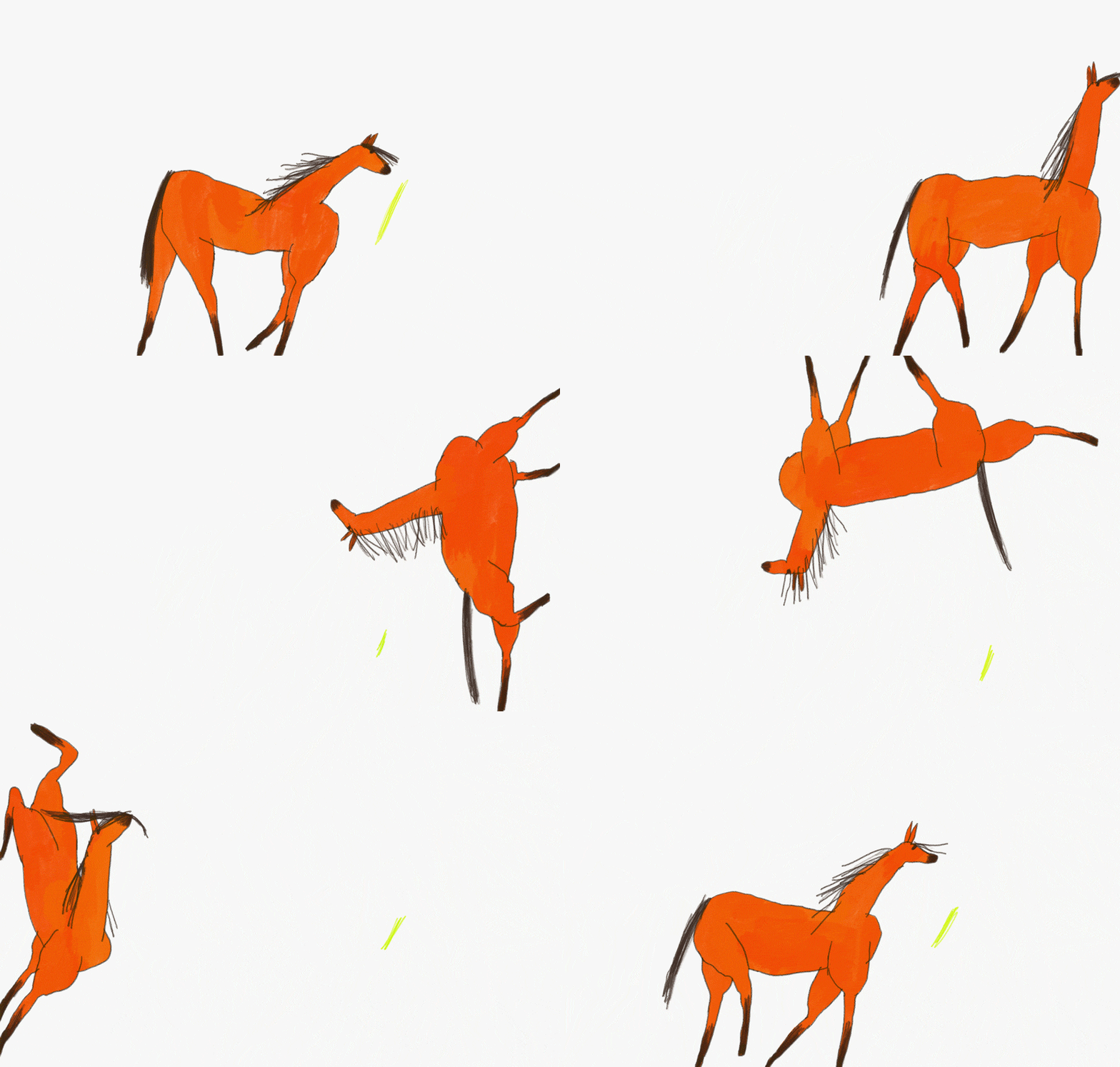
Horse by Nata Metlukh
You can feel in a wobbly line or a frenzied scribble the energy of how it was physically drawn. A precise but not perfect circle shows that a person wanted the idea of “circle carefully drawn by a person” because they could have used a compass or a computer if they wanted a perfect one. A not perfectly round circle might carry the idea “circle drawn quickly” or “circle drawn carelessly” or “circle drawn without much skill”. The particular way of drawing a nose. Messy smeary paint. The relatable imperfections, small or big, intended or unintended. More than most commercial art approaches, a hand-drawn illustration or animation is a legible record of its own creation. We can look at an image and feel that we’re glimpsing someone else’s way of seeing the world, getting a sense of their mind. Humans are interested in that kind of information, even in commercial art.
Given the ongoing reduction in interestingness of photography, live action, 3D, VFX and motion graphics due to AI, innovative overtly-hand-drawn illustration and 2D animation should rise in status.
AI hand-drawn illustration is sometimes convincing, now, and hand-drawn animation is not yet convincing. I’m sure they will improve greatly. However the inherent fakery of making “hand-made” work with AI will keep it a low-information category (for humans anyway) and a low-status move in high-end commercial art.
—
*In 2026 the Eiffel Tower photo could be interesting if someone scanned the brain of a cadaver and retrieved the image from its memory. Or if someone spotted a serial killer in the background or something. But that’s the bar now Eiffel Tower, sorry.
**In future your phone will save space by replacing your photos and videos with the minimum prompt needed to AI-generate them with 95% accuracy, then recreate them when required. Wondering why your baby photos suddenly got way cuter? Compression artifact.