Why do this

I want to think through some of the changes that are happening in my sphere of work and I hope writing will help me organise and clarify my ideas. Also I work by myself and never look at Linkedin so I’m not sick to death of half-baked AI conversations like everyone else. Also I’m sure Megan would prefer me to write than to talk at her about “your favourite subject Julian, AI”. Also I have little kids and I’m getting older and I just feel my brain atrophying in general so maybe writing will help.

It would be ok if anyone responded with really smart stuff so I could a) get better opinions, and b) maybe be their friend. But I intend to put no effort into ‘engagement’ as I don’t like the way my mind starts going when I aim for that.

Unless I say otherwise, everything on this blog is written by me, and not assisted or checked by AI, for better and worse. Thus the content will be less good but more personal.

Hand drawn commercial art in 2026

Ads want attention so they try to pack in a lot of interestingness into a short time. Interestingness, as in unexpected but satisfying decisions. Styles and ideas that you have seen many times before aren’t unexpected; styles and ideas that you have not seen before but appear random and purposeless aren’t satisfying.

Interestingness is separate from amount of visual detail. A hi-res colour photo of the Eiffel Tower has a lot of visual detail and might be a 10MB file. A GIF of a character badly drawn with a mouse in MS Paint contains less visual detail and might only be 25kB. In one sense eiffeltower.jpg contains a lot more information than breakdancingcroissant.gif. But in another sense the Eiffel Tower photo contains only a few creative decisions (location/angle/time of day/lens/shutter/framing/grading) whereas the GIF contains 100s of small drawing decisions.

Interestingness also depends on cultural and technological context. A photo of the Eiffel Tower would be interesting in 1800 given that neither photos or the Eiffel Tower had been invented yet. But it’s uninteresting in 2026 because the subject and the technology are very familiar.* A GIF may be more interesting in 2026 than in 1996, as the 2026 version implies a deliberate choice of medium, not technical limitations. In the context of a 2026 TV ad the MS Paint style is much more unexpected than live action and could be satisfying if the choice made sense for the ad concept.

AI has changed the tech context and lowered the interestingness of some categories of images. “A photo-real image of the Eiffel Tower come to life and rampaging through Paris like a giant robot.” This image would have been somewhat interesting in 2022 because the concept is mildly fun and needed human skill and time to make the tricky decisions involved. It is not interesting in 2026 because it is trivially easy to generate with AI, without making any decisions, so all we’re left with is the mildly fun idea. Even if it’s a 10MB file, the amount of information in the image is merely the prompt “photo-real image of the Eiffel Tower come to life and rampaging through Paris like a giant robot, style of Simon Stalenhag, 9×16” or whatever**. In a 2026 ad such an image communicates different information about the brand than previously. I.e. now it’s ‘we have a small budget and are kinda low brow’. Its cultural status has been reduced to the level of a stock photo.

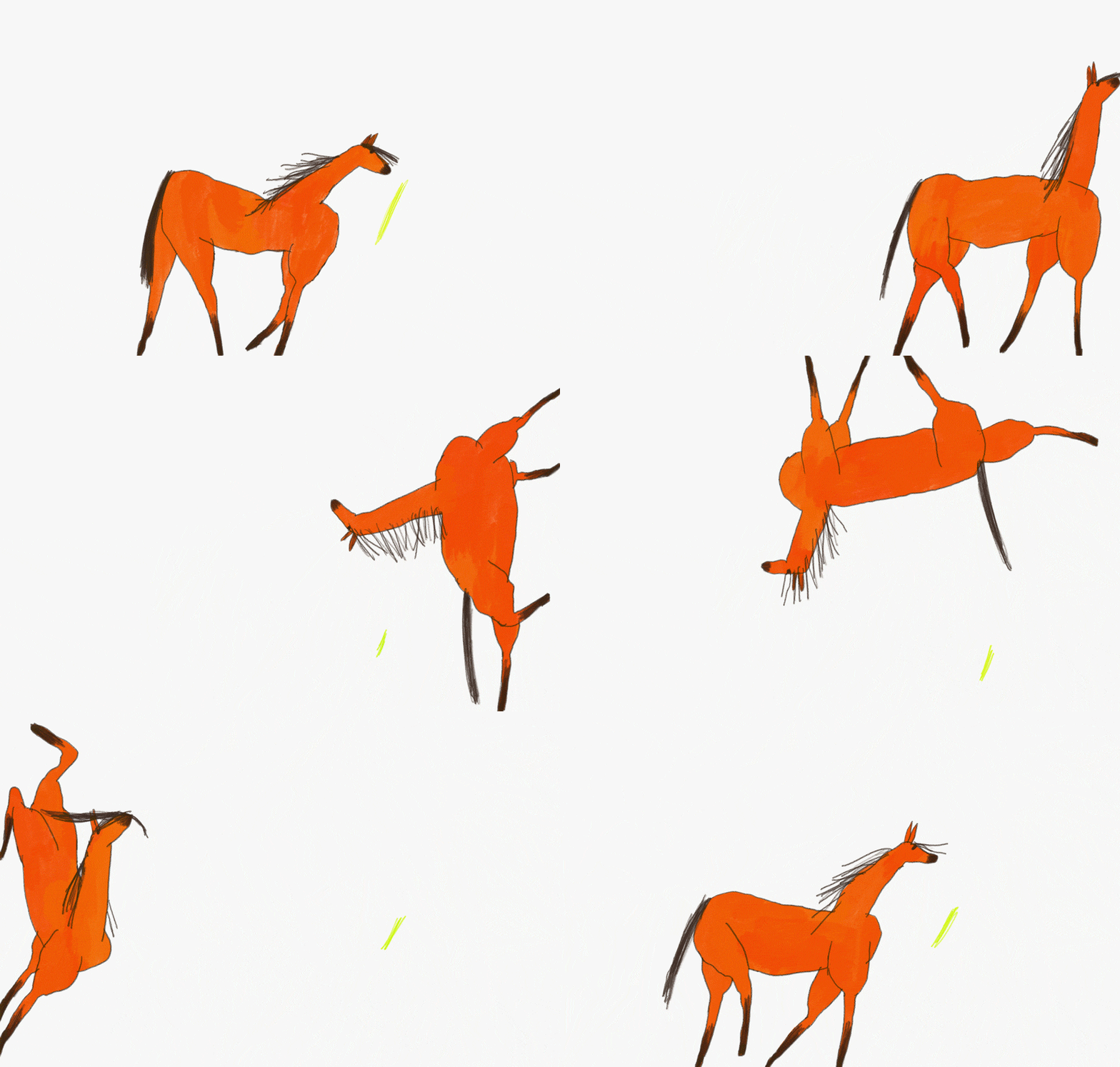
Hand-drawn illustrations and animation have changed less due to AI, so far. They contain big choices about style and medium and many small choices about individual marks. Every part of a drawn image was made by a person so there are many more decisions, conscious and unconscious, contained within it than in a photo.


Horse by Nata Metlukh

You can feel in a wobbly line or a frenzied scribble the energy of how it was physically drawn. A precise but not perfect circle shows that a person wanted the idea of “circle carefully drawn by a person” because they could have used a compass or a computer if they wanted a perfect one. A not perfectly round circle might carry the idea “circle drawn quickly” or “circle drawn carelessly” or “circle drawn without much skill”. The particular way of drawing a nose. Messy smeary paint. The relatable imperfections, small or big, intended or unintended. More than most commercial art approaches, a hand-drawn illustration or animation is a legible record of its own creation. We can look at an image and feel that we’re glimpsing someone else’s way of seeing the world, getting a sense of their mind. Humans are interested in that kind of information, even in commercial art.

Given the ongoing reduction in interestingness of photography, live action, 3D, VFX and motion graphics due to AI, innovative overtly-hand-drawn illustration and 2D animation should rise in status.

AI hand-drawn illustration is sometimes convincing, now, and hand-drawn animation is not yet convincing. I’m sure they will improve greatly. However the inherent fakery of making “hand-made” work with AI will keep it a low-information category (for humans anyway) and a low-status move in high-end commercial art.

—
*In 2026 the Eiffel Tower photo could be interesting if someone scanned the brain of a cadaver and retrieved the image from its memory. Or if someone spotted a serial killer in the background or something. But that’s the bar now Eiffel Tower, sorry.

**In future your phone will save space by replacing your photos and videos with the minimum prompt needed to AI-generate them with 95% accuracy, then recreate them when required. Wondering why your baby photos suddenly got way cuter? Compression artifact.

Joke song

‘You’re Absolutely Right‘

An apology power ballad for these times.
Lyrics by me/Opus/Astra, proud to say Pangram flags as 100% AI. Music by Suno.

War or Sport

I don’t care if my carpet is cleaned/instructions are written/house is built/disease is cured/surgery is performed/country is defended by a person or a machine, just do it really good please.

I do care that the sport I’m watching is played by humans (who aren’t on steroids), the song I’m listening to is written and performed by people, the dancer is a person, the artwork was drawn by a person, the novel or opinion article is written by a person, the friend I’m talking to is a person.

Some stuff the ‘perfect’ version is the point, other stuff the human version is the point.

It’s possible to build a tennis robot that plays tennis better than a person, but it would be much less popular on TV than human players because it would tell us nothing about human physical potential.* Fake artworks aren’t valuable even when they are technically equal to genuine ones because they contain no information about the mind of the real artist. Computer generated music is ok as moodscape but teenagers rarely make it “their music” like they do with popstars because there’s no human creator to scaffold their own search for identity.

When you see human effort you feel like you understand what was hard about it, so you can viscerally admire it. The frontiers of human achievement help everyone answer the question “what are we capable of?” You become more legible to yourself when art eloquently expresses emotions you too have felt. If some art is confusing to me, I make an effort to understand it because I assume there’s an intelligent and understandable point of view behind it. And reputation-based human recommendation helps direct attention to those things in the first place.

Is high-level commercial art** a war or a sport? For businesses, obviously marketing is a war. If AI ads worked as well as human-made ads then bye bye humans, instantly. But for consumers it needs to be at least somewhat a sport. They don’t know or care who made an ad, but for any message they’re supposed to emotionally respond to, they need to feel like there’s some human judgement and creativity in it. Even if AI ads reach or exceed the human level of smart strategy, genuinely insightful and creative ideas, and culturally literate, innovative, appealing execution*** – people won’t emotionally connect with it if they know it’s AI.

In my commercial animation work there is a mix of donkeywork (yet another walk cycle/turnaround) and stuff where my specific point of view is required (creative direction, innate drawing style, eye for gag opportunity), and they aren’t always easy to separate. Sometimes offloading donkeywork frees up time, increases ambition, makes otherwise impossible possible; other times flavour might be lost, creative opportunities might be unknowingly skipped past, productive mistakes might be avoided. So distinguishing between “war” and “sport”**** amongst the various aspects of my work is something I’m still working out.

—
*Also why the old arguments against televised women’s sport due to lower standard of play are missing the point IMO. My car is faster than Usain Bolt, wowee.

**Low-level commercial art, like A/B/C/D-tested ads on instagram for brands you’ve never heard of, that’s definitely ‘war’, AI is great, no one cares if the ads are shit, you encounter them when you feel like shit so it’s probably a plus. Optimising online shopping/fortnite/porn/sports betting/bingewatching/tiktokking/drugtaking reptile-brain stimulation for depressed isolated people who’ve given up on human connection, AI is perfect, that’s just not what I’m talking about.

***Big if. So far AI is amazing at automating definable processes, but bad at making interesting creative leaps. So far it has contributed very little to the cultural frontier.

**** Feel free to suggest a better dichotomy.
Picture books

These are books that my young kids, and crucially, I, like. They are beautiful and great. Either funny or wise or strange or contain a unique little world or all of the above, and they are well-crafted and made for kids. By made for kids I mean the creators understand and respect children, and have taken something they care about and shared it in a personal way. As opposed to say making some trite formulaic junk about the power of friendship or recycling or going to sleep because they think kids are morons, or mindlessly button mashing the What Kids Like™ keypad (magic/farts/dinosaurs/dogs/unicorns/princesses/secret powers/goo/yelling/etc), or making a lovingly designed wistful book for joyless self-involved grownups in the guise of a kids book.

First tier
Frog and Toad by Arnold Lobel
Mouse Tales by Arnold Lobel
Umbra by Jordan Speer
Burglar Bill by Janet and Allan Ahlberg
Each Peach Pear Plum by Janet and Allan Ahlberg
Peepo by Janet and Allan Ahlberg
Ox-Cart Man by Donald Hall and Barbara Cooney
Lily and Friends by Kevin Henkes
George and Martha by James Marshall
Little Mouse Helps Out by Riika Jantti

Second tier
Little Bear by Else Holmelund Minarik and Maurice Sendak (but not the sequels)
The Rainbow Goblins by Ul de Rico
Pancakes for Findus by Sven Nordquist
Need a House? Call Ms. Mouse by George Mendoza and Doris Susan Smith
Cars and Trucks and Things That Go by Richard Scarry
The Story of the Root Children by Sibylle von Olfers
The Tomten by Astrid Lindgren
Brambly Hedge by Jill Barklem
The Little Island by Margaret Wise Brown and Leonard Weisgard
Zoom by Istvan Banyai

I will write some things here soon

I have some accumulated thoughts about commercial animation which I will write down. I hope this will help me think clearly, and maybe even elicit better thoughts from others.